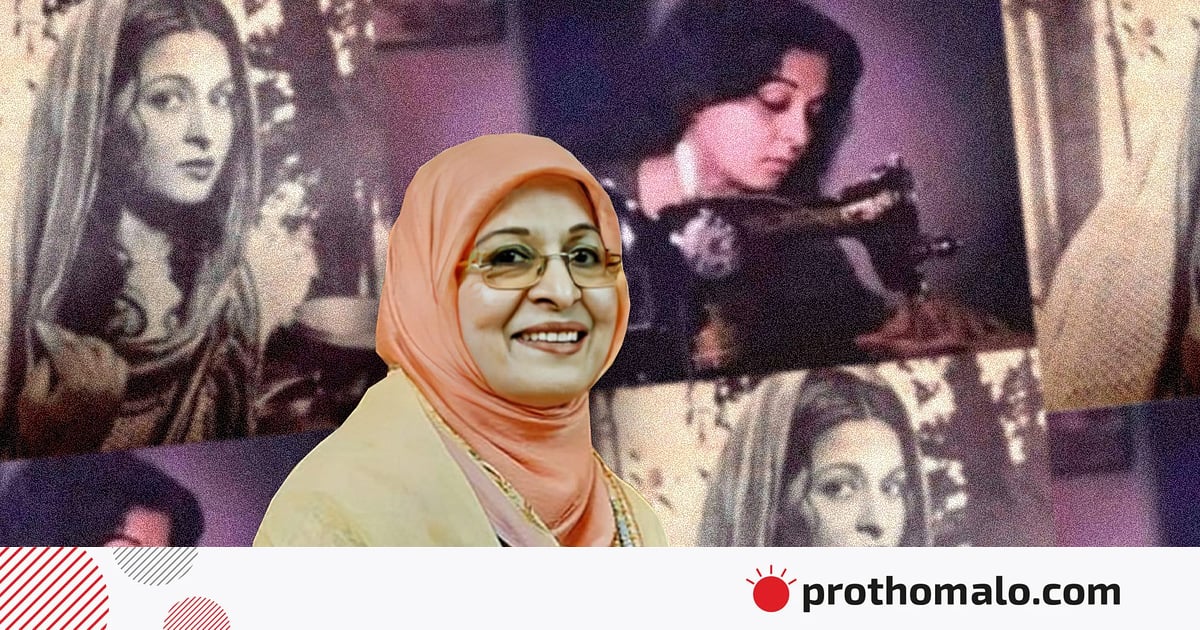
Veteran Bangladeshi actress Shabana has said her decision to walk away from films at the height of her career was driven by her children, not by any loss of interest in acting. In an interview with Prothom Alo, the actress — whose full name is Afroz Sultana Ratna — said she left Bangladesh for the United States so she could be close to her son and two daughters while they studied and settled there. Prothom Alo published the interview on Thursday.
Shabana, known to Bengali-speaking audiences by her single stage name, began appearing on screen as a child of about eight and worked for roughly three decades. According to Prothom Alo, she appeared in 299 films and won 11 National Film Awards, along with a lifetime achievement honour for her contribution to the country's cinema.
Why it matters
Shabana's departure is one of the more closely watched exits in the history of Bangladeshi film. She was a leading heroine from the late 1960s and later moved into character roles as a sister-in-law and mother, remaining a draw across generations of viewers. Prothom Alo reports that she acted opposite Alamgir more than any other co-star, with 130 films together, followed by actor Razzak. Her decision to leave at her peak, and her explanation for it, speaks to a question familiar to working women in many industries: how to balance a demanding public career with raising a family.
From child artiste to leading lady
Prothom Alo traces her start to the early 1960s, when she appeared as a child performer in "Notun Sur," directed by Ehtesham. She became a heroine in 1967 in the same director's Urdu-language film "Chakori."
Her entry into films came about almost by accident. Her father, Faiz Chowdhury, worked as a typist in the Chattogram court area and later directed films himself; her mother, Fazilatunnesa, was a homemaker. Prothom Alo reports that Ehtesham, who knew the family, asked her father to let him cast the girl. Her father objected that Ratna — her nickname — was too shy to appear before anyone. Ehtesham insisted she was exactly the kind of girl he wanted, and her father agreed.
Shabana recalled her first scene for Prothom Alo: she runs in delighted to announce that their elder sister is getting married, and her on-screen brother responds by pulling her close. The shot was approved on the first take. From then on, she said, her father was her biggest source of support and encouragement — more so than her mother — and she went on to act in films he directed, including "Mukti" (1969), "Malka Banu" (1974), "Bijoyini Sonavan" (1979), "Alta Banu" (1982) and "Rajar Meye Bedini" (1991). She noted that "Malka Banu" was a major hit and that its songs are still sung today.
The move abroad
Shabana told Prothom Alo that she had little time for herself from childhood, describing 35 years of continuous work. At a certain point, she said, giving time to her family and children became urgent.
Her elder daughter, Sumi, finished A Levels and went to the United States for higher study; her younger daughter, Urmi, and son, Nahin, followed. Shabana said the children were young and missed her badly, and that she had previously been able to keep them in view while working at home. She concluded that she had responsibilities as a mother and that a successful acting career would mean little if she failed to raise her children properly. She described the choice as painful but necessary.
She credited her husband, producer Wahid Sadik, with supporting the decision. He had business opportunities in the United States, and the family settled there permanently. Shabana told Prothom Alo that she treated the film industry as a family of its own, having worked around the clock and formed close bonds with co-stars and directors, addressing some as brothers and others as uncles. She said she misses them, but that life brings moments when there is no alternative and the right decision must be made at the right time.
Prothom Alo reports that all three children are now established. Sumi Iqbal completed an MBA and married. Urmi Sadik earned a PhD from Harvard University. Nahin Sadik completed a master's degree at Rutgers University, is employed and is also married. Seeing them educated and settled is, by her account, a central achievement of her life.
Still watching from a distance
Shabana has not cut herself off from Bangladeshi cinema entirely. Prothom Alo reports that she follows the industry from the United States as far as Facebook and YouTube allow. She met actor Shakib Khan while she was in Dhaka, when her husband was planning a film production and they spoke with him at their home. She remembered him as handsome, courteous and affable. Prothom Alo adds that Shakib later phoned her while he was in the United States, through a relative of hers.
Shabana's account leaves little room for a reading of her exit as a retreat from the craft. She describes it instead as a trade-off made at a specific stage of life, and one she says she does not regret.
What to watch: whether Shabana's remarks prompt further reflection within the Bangladeshi film industry about the pressures on its leading women, and whether she makes any return to the screen.